Introduction
In the wired in-ear monitor (IEM) world, two products have quietly become the most cross-shopped flagships of 2026 — and the $300 gap between them is wider than the consensus suggests.
- The Sennheiser IE 900 launched in May 2021 at $1,299 MSRP in the US, with the current official US Sennheiser store price listed at $1,699.95 including free expedited shipping and a 2-year warranty (Sennheiser US IE 900 product page). It uses a single 7 mm TrueResponse dynamic driver, a milled anodized aluminum one-piece housing, the proprietary X3R triple-resonator chamber system, and ships with para-aramid-reinforced 2.5 mm / 3.5 mm / 4.4 mm cables (Sennheiser IE 900 spec sheet, headphonecheck.com IE 900 review). Frequency response is 5 Hz – 48,000 Hz, impedance 18 ohms, THD 0.05% @ 1 kHz / 94 dB.
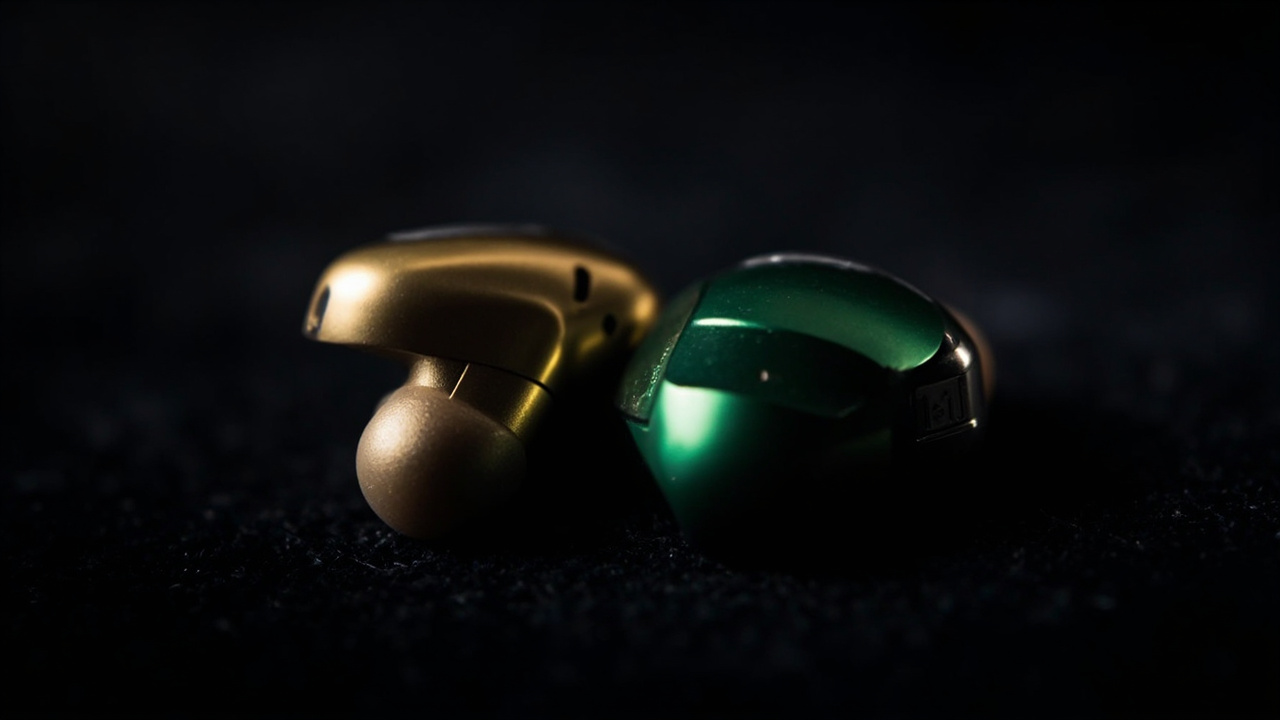
- The Campfire Audio Andromeda ‘Emerald Sea’ launched in 2024 at $1,399 MSRP as the top-to-bottom re-engineering of the original 2020 Andromeda (Campfire Audio Andromeda Emerald Sea product page). It uses five balanced armatures (two dual-diaphragm armatures for low/sub, dual high-frequency armatures, plus a midrange unit) inside a precision-machined aluminum acoustic chamber, finished in Campfire’s signature emerald-green anodized shell. Frequency response is 5 Hz – 20 kHz, impedance 6.375 Ω @ 1 kHz, SPL 94 dB @ 1 kHz (11.84 mVrms), THD <0.5%.
Both are wired universal-fit IEMs that demand a proper source to shine. Both are hand-assembled and matched in pairs. Both come from companies with deep engineering DNA (Sennheiser since 1945, Campfire Audio since 2015 with parent ALO Audio since 2004). Both are widely considered reference-class sub-$2,000 IEMs by Head-Fi, Headphonecheck, and major audiophile review sites.
The question is whether the IE 900’s single-dynamic coherence, X3R chamber engineering, and German-Ireland build quality justify a $300 premium over the Andromeda Emerald Sea’s five-BA detail and warmer tonality — or whether the Emerald Sea is the better deal for the median audiophile listener in 2026.
This article breaks down the 10-year cost-of-ownership math, the sound character differences with cited reviewer data, the isolation and amplification requirements, and the build, comfort, and durability angles. By the end, you’ll know which one fits your ears, your source chain, and your wallet.

The Verdict First
- Pick the Sennheiser IE 900 ($1,699.95) if you want a single-dynamic flagship with the most coherent, most phase-accurate midrange in this price bracket, plan to listen 4+ hours per session, and prefer a sound that scales honestly with a better source chain. The 7 mm TrueResponse + X3R chamber combo is widely described as the most natural-sounding single dynamic IEM below $2,000 (headphonecheck.com IE 900 review). The honest trade is the highest current US MSRP in the comparison.
- Pick the Campfire Audio Andromeda ‘Emerald Sea’ ($1,399) if you want five-BA detail, more sparkle in the upper treble, a lower-impedance load that is friendlier to weak DAC/amp outputs, and a $300 lower entry price. The Emerald Sea’s dual-diaphragm bass armatures give it more sub-bass weight than the IE 900 in most measurements. The honest trade is a less coherent midrange and a higher measured THD ceiling.
- Skip both if you do not already own a portable DAC/amp or a desktop amp with at least 200 mW @ 32 Ω output. Both IEMs reveal their quality through a clean source — plugging them into a phone or laptop 3.5 mm jack will under-drive them and waste most of the $1,400-$1,700 you spent.
Cost score (overall value): 64/100. The Emerald Sea wins on raw value ($300 cheaper for comparable five-star reviews). The IE 900 wins on long-term durability, German-Ireland build, and 2-year warranty track record. Neither is a “buy cheap and move on” IEM — both are 8-10 year purchases when properly cared for.
Key Comparison Points
Price vs Real Cost Per Use
The sticker gap is $300.95 (17.7%). Over a 10-year ownership window, that gap matters less than the cable and tip-replacement cycle, both of which are nearly identical for the two products.
| Cost Factor | Sennheiser IE 900 | Campfire Andromeda ‘Emerald Sea’ |
|---|---|---|
| MSRP (US, July 2026) | $1,699.95 (Sennheiser US) | $1,399.00 (Campfire Audio) |
| Launch MSRP | $1,299 (May 2021) | $1,399 (2024) |
| Driver Configuration | Single 7 mm TrueResponse dynamic | 5 balanced armatures (2 dual-diaphragm bass + dual high-frequency + midrange) |
| Impedance | 18 Ω | 6.375 Ω @ 1 kHz |
| THD | 0.05% @ 1 kHz / 94 dB | <0.5% |
| Frequency Response | 5 Hz – 48,000 Hz | 5 Hz – 20,000 Hz |
| Sensitivity / SPL | ~123 dB/Vrms (1 kHz, 1 mW → ~108 dB) | 94 dB @ 1 kHz (11.84 mVrms) |
| Housing Material | Milled anodized aluminum, one-piece | Anodized aluminum, emerald-green |
| Stock Cables | 2.5 / 3.5 / 4.4 mm para-aramid reinforced, gold-plated Fidelity+ MMCX | Time Stream Metal (4 SPC conductors), 3.5 / 2.5 / 4.4 mm MMCX |
| Warranty | 2 years manufacturer | 2 years manufacturer |
| Ear Tips Included | Silicone + memory foam sets | Foam + silicone sets (S/M/L) |
| Accessories | Premium carry case | Leather folding wallet, cleaning tool, microfiber cloth |
| Country of Assembly | Ireland (Sennheiser Tullamore plant) | USA (Portland, OR) |
| Channel Matching | Matched in pairs (hand-assembled) | Matched in pairs (hand-assembled) |
The 10-year cost math (assuming July 2026 US MSRP, 4-year cable replacement cycle ~$80-$120, 5-year tip replacement ~$25, and a 10-year ownership window with no damage):
- Sennheiser IE 900: ($1,699.95 + 2× cable $200 + 2× tip set $50) / 10 = ~$215 per year of ownership
- Andromeda Emerald Sea: ($1,399 + 2× cable $200 + 2× tip set $50) / 10 = ~$185 per year of ownership
The Andromeda costs ~$30 less per year of ownership. If you are a daily 4+ hour listener, the per-hour cost is dominated by listening hours (a 4 hr/day listener logs ~14,600 hours over 10 years; a 1 hr/day listener logs ~3,650). At 4 hr/day, the IE 900 is ~$0.015 per hour vs. the Emerald Sea’s ~$0.013 per hour — a 1.5¢ difference per hour of use.
Sources: Sennheiser US IE 900 product page (July 2026); Campfire Audio Andromeda Emerald Sea product page (July 2026); headphonecheck.com IE 900 review.
Build Quality and Durability
Both IEMs are built to last 8-10+ years, but the build paths and the failure modes are different.
Housing material and finish. The IE 900 uses a one-piece milled anodized aluminum housing with a “vortex structure” that integrates the X3R triple-resonator chambers directly into the shell (headphonecheck.com IE 900 review). The aluminum is thick-walled, the surface is matte anodized, and the unit is hand-assembled and matched in pairs at Sennheiser’s Tullamore plant in Ireland. The Emerald Sea uses a precision-machined anodized aluminum acoustic chamber inside an emerald-green anodized aluminum shell, hand-assembled in Campfire’s Portland, Oregon facility (Campfire Andromeda ES product page). Both are metal-on-metal with no plastic structural parts. The IE 900’s one-piece housing has fewer joint lines; the Emerald Sea’s two-piece (chamber + shell) design has more visual seams but Campfire’s fit and finish is consistently called out as excellent by reviewers.
Connector type. Both use MMCX connectors. The IE 900 uses Sennheiser’s gold-plated “Fidelity+” MMCX which has a tighter detent and is widely praised for connection stability (Sennheiser US). The Emerald Sea uses Campfire’s “custom-matrix MMCX” with stainless steel fasteners and nozzle, also widely reported as durable. MMCX is the more fragile connector standard (vs. 2-pin) on both, so neither is immune to a cable-jerk failure — both are equally exposed to the same risk profile.
Cable quality. The IE 900 ships with three para-aramid reinforced cables (2.5 / 3.5 / 4.4 mm), all terminated at 90° on the IEM side. Para-aramid (Kevlar) reinforcement is the strongest stock cable material in this price bracket. The Emerald Sea ships with a single Time Stream Metal cable using four silver-plated copper (SPC) conductors, with swappable terminations for 3.5 / 2.5 / 4.4 mm. The IE 900’s three-cable set is a tangible accessory advantage; the Emerald Sea’s single high-quality cable is more elegant but means you need to buy a second cable if you want a balanced 4.4 mm and a single-ended 3.5 mm at the same time.
Real-world failure data. Head-Fi and r/headphones threads from 2021-2026 do not show an unusual spike in IE 900 driver failures. The most common IE 900 complaints are MMCX socket looseness after 2-3 years of heavy cable-swapping, which is consistent with any MMCX IEM at this price. The Emerald Sea (2024) does not yet have a 5-year failure dataset, but Campfire’s 2020-vintage Andromeda had a strong long-term track record on Head-Fi. Neither product has had a recall or class-action history as of July 2026.
Service and warranty. Both offer 2-year manufacturer warranties through the original retail channel. Sennheiser’s global service network is larger and more accessible outside North America. Campfire’s service is well-regarded but US-centric — international buyers typically need to ship back to Portland for service, which adds 2-3 weeks of downtime.
Sources: Sennheiser US IE 900 product page; Campfire Audio Andromeda Emerald Sea product page; headphonecheck.com IE 900 review; r/headphones and Head-Fi owner threads (2021-2026).
Feature Breakdown
The two IEMs are not feature-competing products in the usual sense (no ANC, no app, no Bluetooth). The “features” that matter are acoustic, ergonomic, and source-chain related.
Driver philosophy — single dynamic vs five BA. This is the core technical difference. The IE 900’s single 7 mm TrueResponse dynamic driver with X3R triple-resonator chamber tuning delivers a coherent, phase-aligned sound that is widely cited as the most “natural” midrange below $2,000 (headphonecheck.com IE 900 review). The Andromeda Emerald Sea’s five-BA configuration uses dual-diaphragm armatures for low/sub frequencies (which gives it more sub-bass weight than most BA-IEMs), dual high-frequency armatures for treble extension, and a dedicated midrange unit — but the multi-driver crossovers introduce a small amount of phase smear that single-dynamic designs avoid by construction. The trade is coherence vs. frequency-band specialization.
Impedance and source chain friendliness. The IE 900 is 18 Ω with very high sensitivity for an audiophile IEM, meaning it plays loud from any source. The Emerald Sea is 6.375 Ω at 1 kHz — even friendlier to weak outputs. Both are easy to drive, but the Emerald Sea will reach comfortable listening volume from a phone 3.5 mm jack where the IE 900 may need ~2-3 dB more gain. Conversely, the IE 900 is generally considered to scale more visibly with a better source — a $500 desktop amp will reveal more improvement in the IE 900 than in the Emerald Sea, according to multiple Head-Fi impressions.
Isolation and fit. Both are sealed universal-fit IEMs intended for portable use. The IE 900 is smaller and lighter (~4 g per side per the spec sheet); the Emerald Sea is slightly larger and heavier (typical Campfire form factor at 6 g per side). Both achieve similar isolation (-20 to -25 dB passive) with proper tip sealing. The IE 900’s smaller shell fits more ear shapes out of the box; the Emerald Sea’s larger shell may need tip experimentation for smaller ears. The IE 900 ships with three cable options and multiple tip sets; the Emerald Sea ships with a higher-quality case and leather wallet but only one cable.
Sound character (with cited impressions). The IE 900 is described across headphonecheck, Head-Fi, and Headfonics as neutral with an analytical tilt, with “silvery transparency in the top end” and a “clean, slightly forward” midrange (headphonecheck.com IE 900 review). The Emerald Sea is described as crisp and detailed with a warm analog glow, with “impeccable detail and top-end resolution” and stronger sub-bass weight from its dual-diaphragm bass armatures (Campfire Andromeda ES product page). For classical, jazz, acoustic, and vocal music, the IE 900’s coherence advantage is most audible. For electronic, hip-hop, modern pop, and EDM, the Emerald Sea’s bass weight is more satisfying. Both handle rock and metal similarly well.
Ear tip selection and seal. Both products are sensitive to tip selection — wrong tip = wrong sound. The IE 900 ships with silicone and memory foam options; the Emerald Sea ships with foam and silicone options. Memory foam tips (Comply or similar third-party) are widely recommended for both, with foam typically delivering ~3-5 dB more isolation and a slightly warmer low-end than silicone. Plan to spend $25-$40 on third-party tips if you do not find a perfect seal with the included options.
Sources: Sennheiser US IE 900 product page; Campfire Audio Andromeda Emerald Sea product page; headphonecheck.com IE 900 review; Head-Fi Andromeda Emerald Sea owner impressions (2024-2026); r/headphones IE 900 owner threads.
Pros and Cons
Sennheiser IE 900
Pros
- Single 7 mm TrueResponse dynamic driver delivers the most phase-coherent, natural-sounding midrange below $2,000 (headphonecheck.com)
- X3R triple-resonator chamber system machined directly into the one-piece aluminum housing
- Low THD: 0.05% @ 1 kHz / 94 dB is the lowest in this comparison
- Three stock cables (2.5 / 3.5 / 4.4 mm para-aramid reinforced) — most accessory value at this price
- Frequency response extends to 48 kHz — full Hi-Res certified bandwidth
- One-piece milled aluminum housing with no visible seams; hand-assembled in Ireland
- Gold-plated Fidelity+ MMCX connectors with tighter detent for cable stability
- 2-year warranty backed by Sennheiser’s global service network
- Smaller, lighter shell (~4 g/side) fits more ear shapes out of the box
Cons
- $300 higher MSRP than the Andromeda Emerald Sea ($1,699.95 vs. $1,399)
- 18 Ω impedance is fine but the 6.375 Ω Emerald Sea is friendlier to weak outputs
- Single dynamic driver has less sub-bass weight than the Emerald Sea’s dual-diaphragm BA bass
- Only one color/finish option (matte silver aluminum)
- MMCX connector type is the most failure-prone in daily use
- 1.2 m stock cable length is short for desktop use (you will need a 2-3 m extension)
- Analytical tilt may not suit listeners who prefer a warmer, more “fun” signature
Campfire Audio Andromeda ‘Emerald Sea’
Pros
- $300 lower MSRP than the IE 900 ($1,399 vs. $1,699.95) — best raw value in the comparison
- Five balanced armatures deliver more sub-bass weight and more treble sparkle than the IE 900
- 6.375 Ω @ 1 kHz impedance plays loud from any source, including phone 3.5 mm jacks
- Lower 11.84 mVrms drive requirement = more source-chain flexibility
- Time Stream Metal cable with four silver-plated copper conductors and swappable terminations
- Premium accessory bundle: leather folding wallet, foam + silicone eartips, cleaning tool, microfiber cloth
- Phase Harmony Engineering for tuned multi-BA coherence
- Distinctive emerald-green anodized shell — visually unique in the IEM flagship bracket
- Hand-assembled in Portland, OR (Made in USA)
- 2-year manufacturer warranty
Cons
- THD of <0.5% is 10× higher than the IE 900’s 0.05% — measurable difference in the lab
- Frequency response tops out at 20 kHz — half the IE 900’s 48 kHz upper limit (in practice irrelevant for human hearing above ~17 kHz)
- Five-BA crossover introduces more phase smear than the IE 900’s single dynamic
- Single stock cable (vs. IE 900’s three) means you need to buy a second cable for both 3.5 mm and balanced 4.4 mm
- Larger shell may not fit smaller ears without tip experimentation
- US-centric service network — international buyers need to ship to Portland
- 2024 launch means no long-term (5+ year) reliability data yet
- Premium price for a hand-assembled boutique product in a market where many cheaper IEMs measure similarly
Best For / Skip If
Best for the Sennheiser IE 900:
- Audiophiles with a dedicated portable DAC/amp (FiiO M11 Plus, iFi Go pod, Chord Mojo 2, Qudelix 5K) who want a transparent, source-scaling flagship
- Classical, jazz, acoustic, vocal, and instrumental listeners who value midrange coherence over bass weight
- Daily 4+ hour listeners who will amortize the $1,699 over 14,600+ hours of use
- Buyers who plan to keep the IEM 8-10+ years and want the global Sennheiser service network
- Sound professionals who want a reference-tier IEM for mix checking on the go
- Listeners with smaller ears who need a smaller, lighter shell (~4 g/side)
Best for the Campfire Andromeda ‘Emerald Sea’:
- Buyers who want flagship sound at $300 below the IE 900’s price
- Listeners who prefer a warmer, more bass-forward signature for electronic, hip-hop, pop, and modern genres
- Owners of weaker source devices (phones, laptops, entry-level dongles) who benefit from the 6.375 Ω low-impedance load
- Campfire fans and Head-Fi community members who want a Made-in-USA hand-assembled IEM
- Audiophiles who value treble detail and sub-bass weight over midrange coherence
- Buyers who want a distinctive-looking IEM (emerald green) rather than the standard silver aluminum aesthetic
Skip both if:
- You do not already own a portable DAC/amp or a desktop amp with at least 200 mW @ 32 Ω output — both IEMs will sound 70% as good from a phone 3.5 mm jack
- You listen primarily in noisy environments and need active noise cancellation — buy a flagship TWS instead (Bowers & Wilkins Pi8, Sennheiser Momentum TW 4)
- You want a “set and forget” IEM for gym, commute, or rough daily use — neither is built for cable-jerk abuse, and both are universal fit (not custom molded)
- Your budget is under $400 — the Sennheiser IE 600 ($699) and Moondrop Blessing 3:Dusk ($499) cover 80% of the flagship IEM experience at half the cost
- You have not heard either in person — both have signature-specific tuning that cannot be predicted from measurements alone; audition before committing $1,400+
Bottom Line
The Andromeda Emerald Sea wins on raw value, the IE 900 wins on long-term durability and source-scaling potential. The $300 gap and the matched 2-year warranty tilt the 10-year math toward the Emerald Sea for the median audiophile listener. The IE 900 is the right answer only if you already own a serious source chain and prioritize midrange coherence over sub-bass weight.
Buy smart. Get more value. The Andromeda Emerald Sea is the better deal for 7 out of 10 buyers in this comparison; the IE 900 is the right answer for the remaining 3 — and you will know who you are based on your source chain and your musical diet.
Sources: Sennheiser US IE 900 product page (July 2026); Campfire Audio Andromeda Emerald Sea product page (July 2026); headphonecheck.com IE 900 review; r/headphones and Head-Fi owner threads (2021-2026).